-
-

-
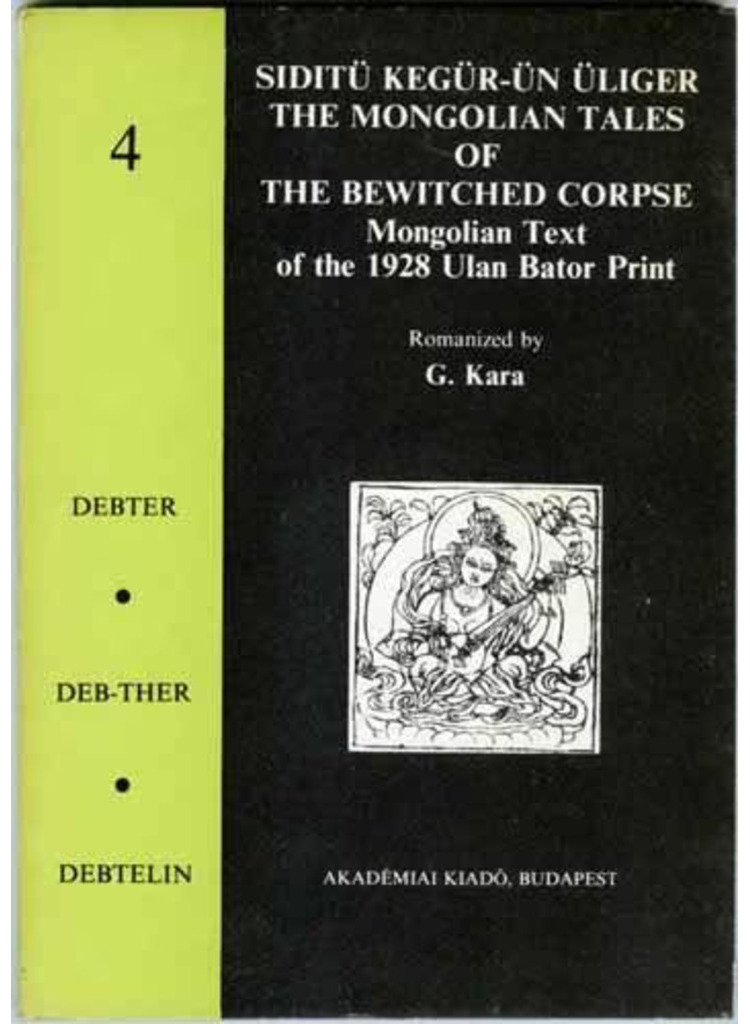
Siditü Kegür-ün Ülger of the Mongolian Tales of The Bewitched Corpse
0800 FtThis is the Romanized version of the Mongolian Tales of the Bewitched Corpse according to the 1928 Ulan Bator printed Uighur-Mongolian text Siditü kegür-ün üliger (reset and re-edited in Kökeqota, 1957). The transcription which I prepared as a student under the- guidance of Professor Louis Ligeti was originally published in 1959 as a university text-book (Mongol szövegek I, Siditü kegür-ün üliger. Az elvarázsolt holttest meséi. Felsőoktatási Jegyzetellátó Vállalat, Budapest, III 86 p . , lithogr.) and served as the source material for some literary and folklore researches. The copy of the Ulan Bator print I used belongs to Professor Ligeti’s library. Here I amend some of my errors and update the transcription. Pagination given in the text in brackets follows that of the Ulan Bator print. Traditional readings like bui (for bűi), buyu (for büyü), buu (for bü), ou (also for ей) , and kü (written in fact ku) are maintained and readings like mön, mören, and öndür correspond to the later forms (and not to Middle Mong. műn, müren, ündür), but instead of the non-first syllable convention reading only и or ü for a labial vowel, I tried to utilize the evidence of the earlier monuments and the dialects (as it was done e.g. by Antoine Mostaert in the Written Mongolian forms quoted in his Ordos dictionary), although it would be in vain to think that a uniform transcription could properly reflect the complexity of the underlying dialects of the past (cf. e.g. ordu and ordo; silüsün, Ordos sölösü, khalkha süls, etc.). The text (of the 26 tales framed in the 27th or Oth) with its variety of content and vocabulary still offers a good tool for mastering Written Mongolian and presents a number of questions to be solved for the student of language and literary history, including e.g. the Tibeto-Mongolian oral and written transmission of tales and stories, their diversity of style, their psychology, the „grammar” of their narrative elements, and their connections beyond the Tibeto-Mongolian world and within.
Honterus Antikvárium és Aukciós Ház